
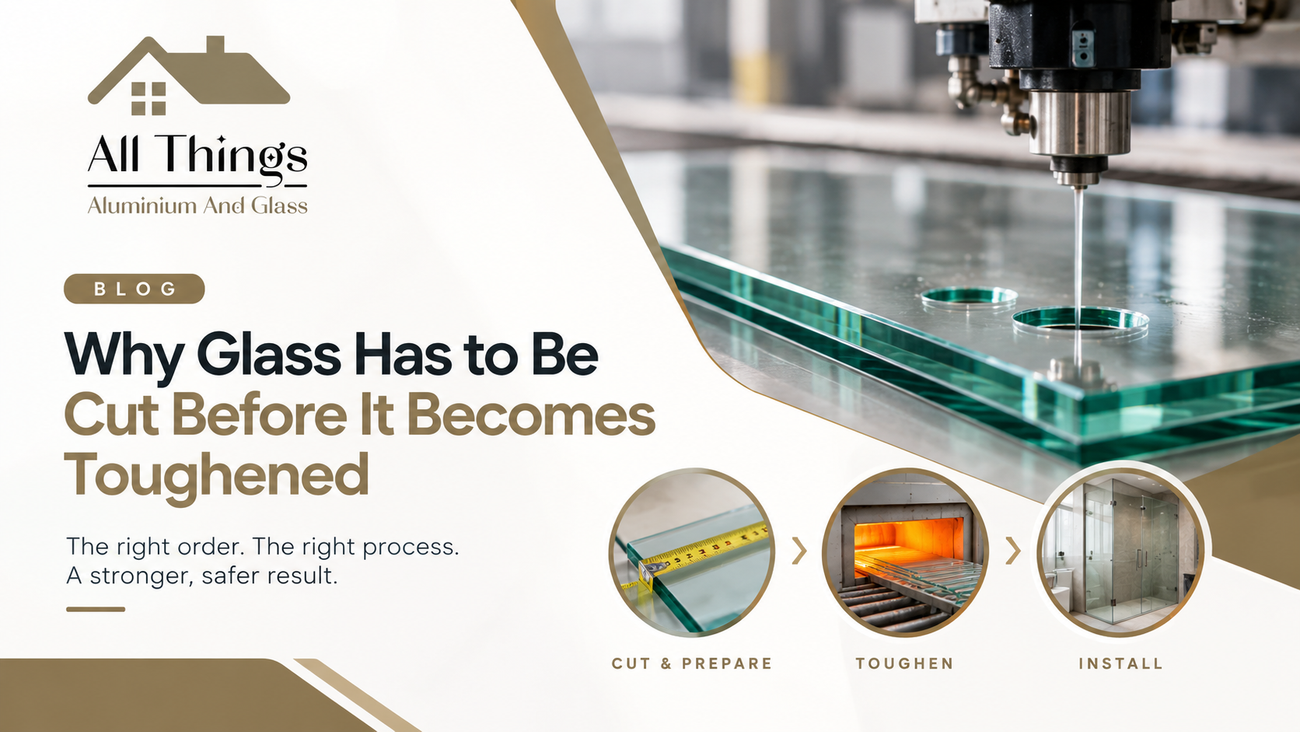
Once toughened glass is finished, changing your mind isn’t as simple as saying, “Can we just trim a little off?”
When you look at a finished glass door, shower panel, office partition or window, it can seem like the glass simply arrived in the perfect shape.
But behind that clean, finished panel is a carefully planned fabrication process.
With toughened glass, also known as tempered glass, most cutting, drilling and other required processing must be completed before the glass is toughened.
And there’s a very good reason why.
First, the Glass Is Cut to Size
Before toughening, the glass can be prepared according to the requirements of its intended application.
This may include:
- Cutting the glass to the required dimensions
- Shaping the panel where necessary
- Polishing or working the edges
- Creating holes for fittings
- Preparing cut-outs for handles, hinges or other hardware
For example, a shower door may require holes for hinges and a handle. A glass partition may need specific cut-outs for fittings.
These details need to be considered before the glass goes through the toughening process.
Once the glass has been toughened, making major changes to the panel is no longer straightforward.
Then Comes the Toughening Process
After the glass has been cut and prepared, it can undergo thermal toughening.
During this process, the glass is heated to a high temperature and then rapidly cooled.
This creates internal stresses within the glass, making it considerably stronger than ordinary annealed glass and changing the way it behaves when broken.
Instead of breaking into large, sharp shards like ordinary glass, properly toughened glass is designed to break into many smaller pieces.
However, the same process that gives toughened glass its strength also means that the finished panel cannot simply be cut, drilled or altered like ordinary glass.
So, Can You Cut Toughened Glass Afterwards?
Generally, no.
Attempting to cut, drill or significantly modify fully toughened glass can cause the entire panel to shatter.
Imagine the glass has already been toughened and someone says:
“Actually, can we move this hole slightly?”
That small change may mean the panel has to be replaced with a new piece of glass.
This is why accurate measurements and specifications are so important before toughened glass is processed.
Why Accurate Glass Measurements Matter
Customers sometimes wonder why a fabricator asks so many questions before ordering or processing glass.
It’s not simply about asking:
“How big is the glass?”
The fabricator may also need to know:
- What will the glass be used for?
- What are the final dimensions?
- Where will the fittings be positioned?
- Are holes or cut-outs required?
- What type of hardware will be installed?
- Does the glass need to be toughened?
- What type and thickness of glass is appropriate for the application?
These details can determine how the glass needs to be cut, processed and prepared before toughening.
Getting the specifications right at this stage can help prevent costly mistakes later.
The Finished Glass Hides a Lot of Planning
That’s one of the fascinating things about glass fabrication.
By the time the glass reaches the installation site, the complicated part can look effortless.
You see a clean glass shower enclosure.
You see a sleek glass door.
You see a modern office partition.
What you don’t see are the measurements, calculations, hardware requirements, edge preparation, holes, cut-outs and fabrication decisions that happened beforehand.
The finished product may look simple, but getting it right requires careful planning.
Why You Can’t “Just Trim a Little Off”
This is perhaps the most important thing to understand about toughened glass.
With ordinary annealed glass, a fabricator can often make certain adjustments after the initial cutting stage.
With fully toughened glass, however, cutting or drilling afterwards can cause the entire panel to break.
That’s why the correct sequence matters:
Measure → Cut → Process → Inspect → Toughen → Install
The exact fabrication sequence can vary depending on the type of glass and application, but the key principle remains the same:
The glass must be properly prepared before it is toughened.
Final Thoughts
Toughened glass is a great example of why glass fabrication is about more than simply making a panel look good.
The order in which things happen matters.
Cut first.
Prepare the necessary details.
Then toughen.
Once the glass has gone through the toughening process, making changes is no longer as simple as trimming a few millimetres or drilling another hole.
At All Things Aluminium & Glass, careful planning, accurate measurements and proper specifications help ensure that every glass panel is prepared for its intended application.
Because changing your mind is always easier…
before the glass enters the furnace.
