
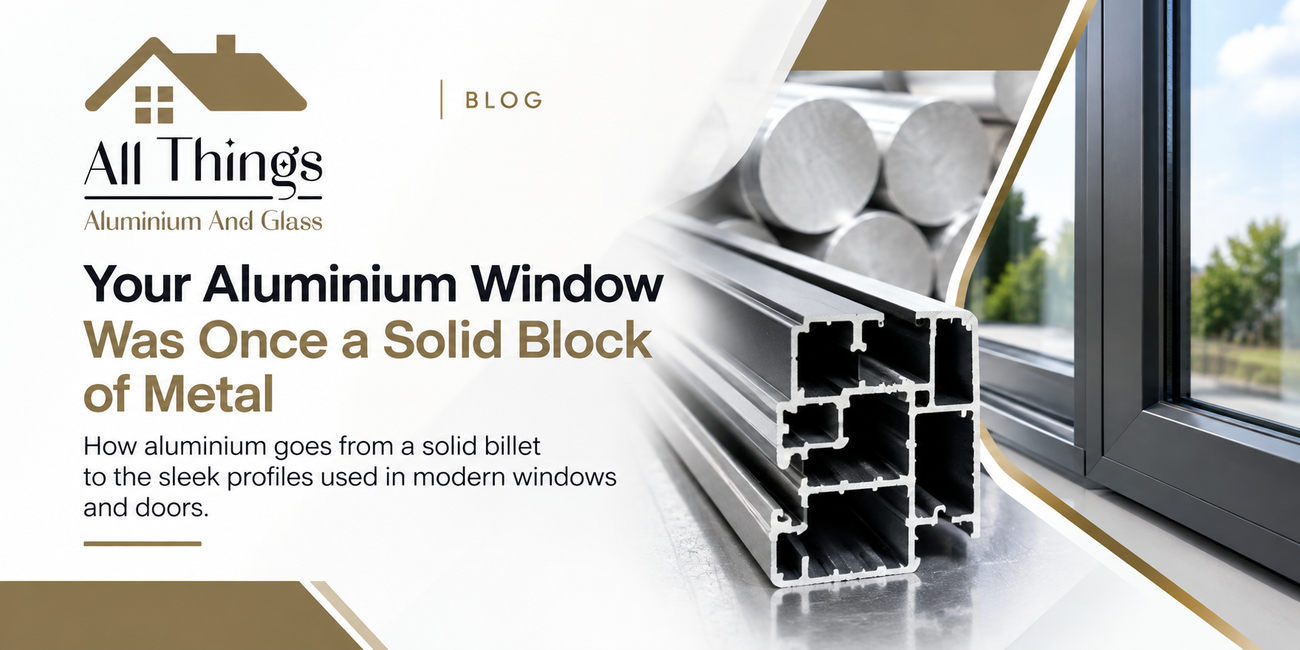
How aluminium goes from a solid billet to the sleek profiles used in modern windows and doors
Look closely at an aluminium window frame.
You’ll notice grooves, channels, hollow sections and tiny spaces designed to accommodate glass, seals, locks and other hardware.
From the outside, the frame may look simple. But look at the cut end of an aluminium profile and you’ll discover something very different — a surprisingly complex shape.
So how does aluminium go from a solid piece of metal to the precise profiles we use for windows and doors?
The answer is aluminium extrusion.
And it’s one of the main reasons aluminium can be transformed into such a wide variety of shapes.
It Starts With an Aluminium Billet
Before aluminium becomes a window or door profile, it can start as a solid cylindrical piece called a billet.
At this stage, it looks nothing like a window frame. It’s simply a thick piece of aluminium waiting to be shaped.
The billet is heated to make the aluminium easier to work with. Once it reaches the appropriate temperature, it is ready for the extrusion process.
And this is where things get interesting.
Meet the Extrusion Die
The die is one of the most important parts of the extrusion process.
It is a specially engineered tool with an opening designed to create the exact cross-sectional shape required for the aluminium profile.
A simple way to picture it is to think about a piping nozzle used to decorate a cake.
Change the nozzle, and the shape of the icing changes.
Aluminium extrusion works on a much larger industrial scale, but the basic principle is similar.
The heated aluminium is forced through the shaped opening in the die under very high pressure.
As the aluminium emerges from the other side, it takes on the shape of the die.
A solid billet has now been transformed into a long, continuous aluminium profile.
So Where Do All Those Channels Come From?
This is the clever part.
An aluminium profile isn’t simply a flat or solid piece of metal that is shaped later into a window frame.
Its cross-section can be engineered from the beginning to include the features required for a particular application.
That can include:
- Hollow chambers
- Grooves and channels
- Recesses for glass
- Spaces for seals
- Areas for hardware
- Interlocking sections
- Reinforcing features
This is why the cut end of an aluminium profile can look so complicated.
What may appear to be a small groove or hollow section can have an important function within the finished window or door system.
One Long Profile Isn’t a Window Yet
Coming out of the extrusion process doesn’t mean the aluminium is ready to be installed in a building.
The long extruded profiles still need additional processing and finishing before they become part of a finished window, door or other architectural system.
At the fabrication stage, the appropriate profiles are:
Measured → Cut → Machined → Assembled → Fitted with glass and hardware
The exact processes depend on the type of system being produced.
Corners are joined, hardware is incorporated, glass is fitted and the individual components are assembled into a finished product.
Eventually, what started as a solid aluminium billet becomes the frame surrounding a window in someone’s home, office or commercial building.
Why Is Aluminium So Useful for This?
One of aluminium’s key advantages is its ability to be extruded into complex shapes.
This gives manufacturers and designers considerable flexibility when developing systems for:
- Aluminium windows
- Doors
- Office partitions
- Shopfronts
- Curtain walls
- Other architectural applications
Instead of using basic solid bars for everything, profiles can be engineered around the specific job they need to perform.
That is why an aluminium frame can look clean and minimal from the outside while containing a surprisingly detailed structure inside.
Take a Look at the End of an Aluminium Profile
The next time you’re in an aluminium workshop, take a safe look at the cut end of an unused profile.
Don’t just look at the outside.
Look at the cross-section.
You’ll see that the shape continues all the way through the length of the profile.
That’s when you start to appreciate the engineering behind what can otherwise look like a simple strip of metal.
Those grooves aren’t there by accident.
Those hollow sections aren’t just for appearance.
The entire profile has been designed with a purpose.
From Extrusion to Your Finished Window
There is a fascinating journey behind every aluminium window.
It begins with aluminium.
The aluminium is formed into a billet, heated and pushed through a precisely designed die to create the required profile.
That profile is then processed, finished and eventually supplied to fabricators.
From there, it can be cut and assembled into a window, door, partition, shopfront or another aluminium system.
By the time it reaches your home or building, it has gone through several stages of manufacturing and fabrication.
The Bottom Line
We often talk about what aluminium becomes:
A window.
A door.
A partition.
A shopfront.
A curtain wall.
But rarely do we think about how the aluminium got its shape in the first place.
Long before an aluminium profile reaches a fabricator, an extrusion process has already transformed the metal into a carefully engineered shape ready for the next stage.
So the next time you look at an aluminium window frame, remember:
It didn’t start as a window.
It started as aluminium — and through engineering, extrusion and fabrication, it became part of the space around you.
At All Things Aluminium & Glass, we take those profiles and turn them into practical, finished aluminium and glass solutions designed around real spaces, measurements and projects.
You dream it, we build it.
