
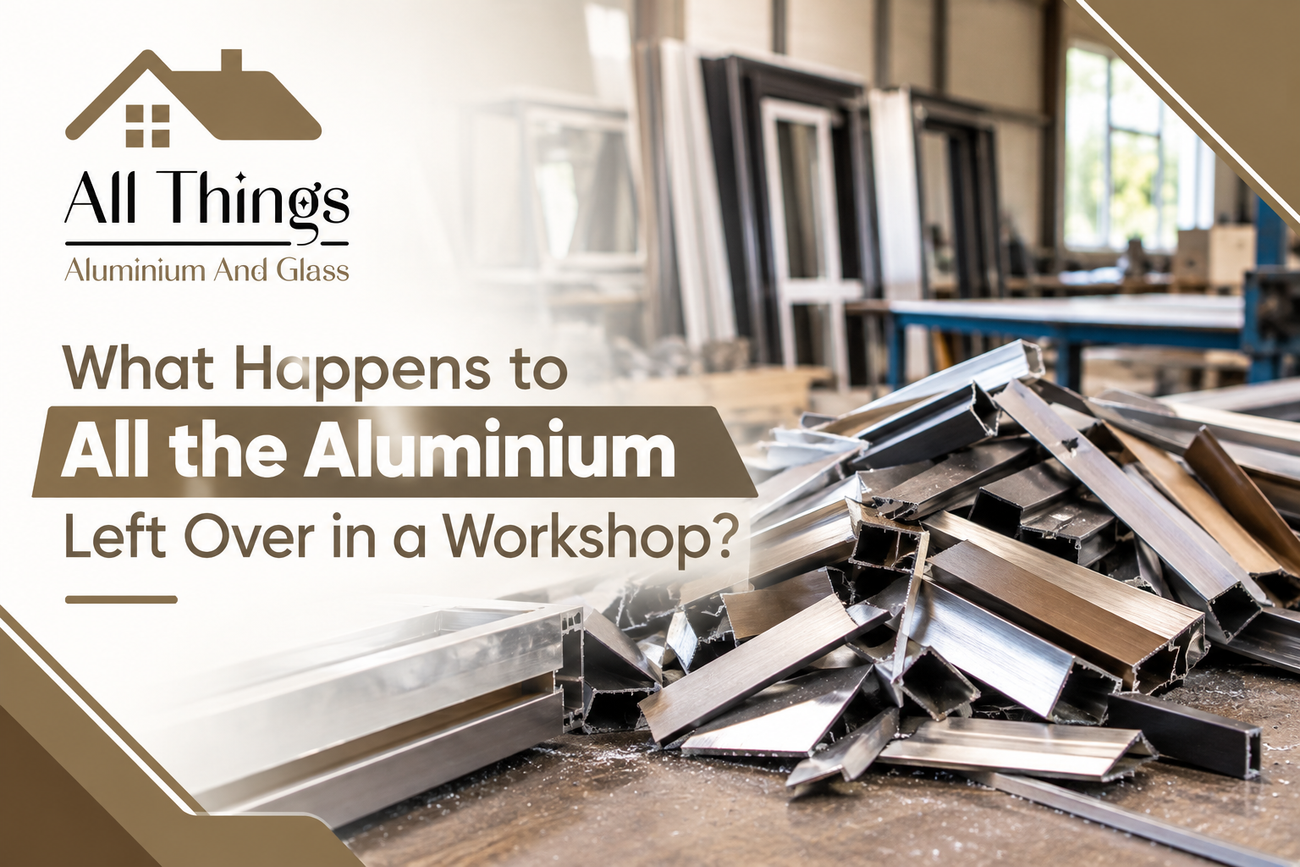
The window is finished. The door frame is complete. But what happens to all those little pieces of aluminium left behind?
Walk into an aluminium fabrication workshop and you’ll probably see long aluminium profiles being measured, cut and prepared for different projects.
A window might require one length.
A door might need another.
A partition could require something completely different.
And once all that cutting is finished, there are inevitably pieces left behind.
So, where do they go?
Are they simply rubbish?
Not necessarily.
One of aluminium’s most interesting qualities becomes important after the cutting is finished: aluminium can be recycled again and again.
✂️ Every Project Creates Offcuts
Aluminium profiles arrive at a workshop in standard lengths. Buildings, however, don’t come in standard sizes.
One customer may need a large sliding window, while another may need a small bathroom window, a different door system or a custom-sized partition.
Fabricators therefore measure and cut aluminium profiles according to the exact dimensions of each project.
This process inevitably creates smaller pieces known as offcuts.
Some may be large enough to be useful for another project. Others may eventually become aluminium scrap.
But scrap doesn’t automatically mean useless.
♻️ Aluminium Can Have Another Life
Here’s where aluminium gets interesting.
Unlike materials that can become difficult to recover after their original use, aluminium can be melted down and recycled into new aluminium products.
Importantly, aluminium can be recycled repeatedly without inherently losing its basic properties through the recycling process.
So, a piece left over after making today’s window doesn’t necessarily have to be the end of the story.
It could become part of another aluminium product in the future.
⚡ Recycling Aluminium Uses Much Less Energy
This is one of the most impressive things about aluminium recycling.
Producing new aluminium from raw ore requires a significant amount of energy. Recycling existing aluminium, however, requires only about 5% of the energy needed to produce primary aluminium.
That means recycling aluminium can save roughly 95% of the energy compared with producing primary aluminium from raw materials.
Suddenly, those little workshop offcuts don’t look quite so insignificant.
They are part of a material stream that can continue beyond the workshop.
🏭 So, What Happens to Scrap Aluminium?
Where recycling systems are available, aluminium scrap can be collected, sorted and separated before being sent to recycling facilities.
The scrap is then processed and melted, allowing the aluminium to be used again in the production of new products.
It may not return as the exact same type of window frame it started as. The recycling and manufacturing chain is much bigger than a single workshop.
But the important thing is that the aluminium itself can continue into another useful life.
That’s one reason aluminium scrap can have value rather than simply being treated as ordinary waste.
🪟 The Story Can Continue Beyond the Workshop
Now think beyond the small offcuts created during fabrication.
Eventually, even an old aluminium window or door may reach the end of its useful life.
The glass can be removed.
The hardware can be separated.
And the aluminium frame can potentially enter the recycling stream.
So, an aluminium window doesn’t necessarily become waste simply because a building is being renovated or an old frame is being replaced.
The material may have another life ahead of it.
🌍 Why Does This Matter?
When we think about construction, we usually focus on what is being added to a building:
New windows.
New doors.
New partitions.
New curtain walls.
But responsible use of materials also means thinking about what happens to the materials left behind.
Choosing materials that can be recovered and recycled can help reduce the need to continually rely on newly extracted raw materials.
And when you’re working with aluminium, even the scraps can have value.
🏗️ What This Means in an Aluminium Workshop
At All Things Aluminium & Glass, every project begins with measurements and specifications that determine how aluminium profiles are cut and fabricated.
Whether we’re creating custom windows, doors, partitions or other aluminium-and-glass solutions, accurate measurement and careful fabrication are important parts of the process.
And behind every finished installation is a workshop where material is measured, cut, assembled and, where possible, leftover material is kept within the appropriate recycling stream.
Because good fabrication isn’t only about creating the finished product.
It’s also about being thoughtful about the materials used along the way.
Final Thoughts
A tiny piece of aluminium lying on a workshop floor might not look particularly important.
But it represents something bigger.
A material doesn’t necessarily become useless simply because its first job is finished.
Aluminium can continue through the recycling cycle and become part of something new.
At All Things Aluminium & Glass, we design, fabricate and install aluminium and glass solutions tailored to each project.
Because sometimes…
What’s left over isn’t really the end.
🔍 Next Time You See an Aluminium Offcut…
Don’t immediately think of waste.
Think:
What could this become next? ♻️
You dream it, we build it.
