Ask for “clear glass” and you might think the decision is already made. Surprisingly, it may only be the beginning.
Clear is clear… right?
That’s what most of us assume.
If you can see through the glass, surely one piece of clear glass should look pretty much like another.
Not quite.
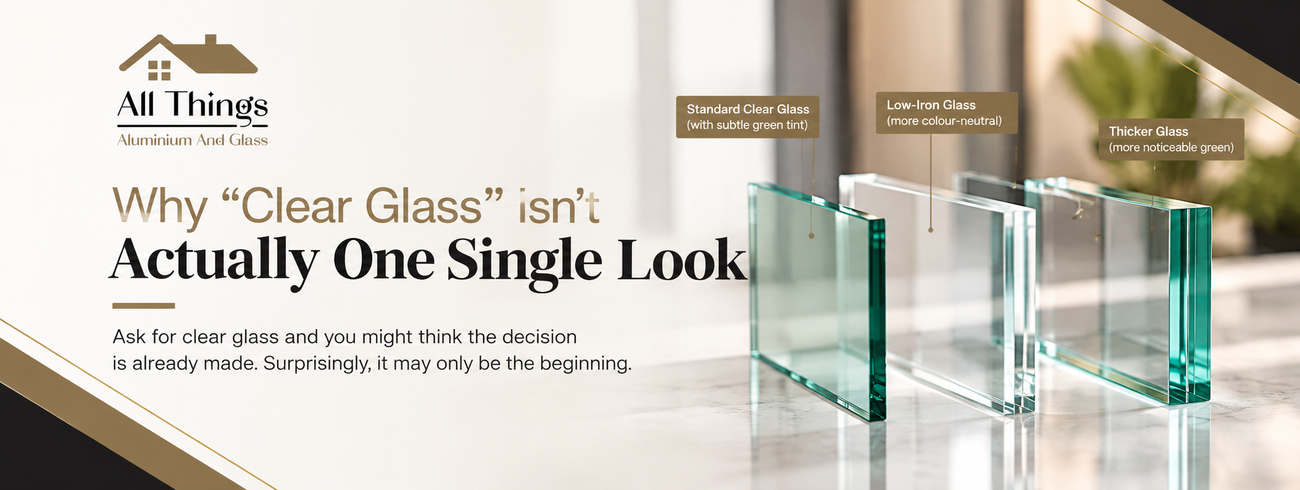
Put different types of architectural glass side by side and you may notice something unexpected:
- One may have a subtle green tint.
- Another may look more colour-neutral.
- The difference can become even more noticeable around the edges of thicker glass.
So, what’s actually happening?
💚 That Slight Green Colour Isn’t Your Imagination
Standard clear float glass can naturally have a slight green appearance.
One of the main reasons is the presence of iron in the raw materials used to manufacture the glass.
And the thicker the glass, the more noticeable this colour can become.
That’s why a window may look almost completely clear when you look straight through it…
…but the edge can reveal a much stronger green colour.
Nothing is wrong with the glass. It’s simply a natural characteristic of standard clear glass.
🪟 What About Low-Iron Glass?
This is where low-iron glass comes in.
Low-iron glass is manufactured with reduced iron content, which helps minimise the green appearance found in conventional clear glass.
The result?
Greater colour neutrality and visual clarity.
This can be especially useful in applications where accurate colour representation matters, such as:
- 🏪 Shopfronts and retail displays
- 🖼️ Display cases
- ✨ Premium interiors
- 🏢 High-end architectural features
If you want the glass to interfere with the view as little as possible, low-iron glass may be worth considering.
📏 Thickness Can Change What You See
Here’s something many people don’t realise:
Glass thickness can affect its appearance.
Two pieces of glass can be made from the same general type of material but look slightly different when one is thicker.
Why?
Because light has to travel through more glass.
The natural colour characteristics of the material become more noticeable as the thickness increases.
That’s why you might barely notice any tint when looking through a thin pane…
…but see a much stronger green colour when looking along the edge of a thicker piece.
☀️ Your Surroundings Also Matter
Glass doesn’t exist in a blank white room.
Its appearance can change depending on:
Lighting.
The amount and type of light around the glass can affect how you perceive its colour.
What’s behind it.
Wall colours, furniture and other materials can influence how the glass looks.
Viewing angle.
Glass can appear different when viewed straight on compared with looking across its surface or edge.
Reflections.
The surrounding environment can create reflections that change the way the glass is perceived.
This is why choosing glass based on a small sample alone doesn’t always tell the full story.
The actual installation environment matters.
🏪 When Does Clarity Really Matter?
Imagine a shop displaying brightly coloured clothing behind a large glass frontage.
Or a showroom where customers need to see products in their true colours.
In these situations, the visual characteristics of the glass can matter significantly.
But for another project, the subtle green tone of standard clear glass may make virtually no noticeable difference.
There is no one-size-fits-all answer.
The right choice depends on the application, appearance you want and functional requirements of the project.
🔍 “Clear” Is a Starting Point — Not the Whole Specification
When choosing glass, the conversation shouldn’t stop at:
“Clear or frosted?”
Depending on the project, you may also need to consider:
- Glass thickness
- Safety requirements
- Privacy
- Colour and appearance
- Location
- Glass size
- Intended use
- Performance requirements
In other words, “clear glass” describes the basic appearance — but it doesn’t tell the whole story.
✨ The Bottom Line
Glass may look simple, but there is more to it than meets the eye.
Even something labelled “clear” can have different visual characteristics depending on its composition, thickness, surroundings and intended application.
At All Things Aluminium & Glass, we believe customers should understand the materials going into their projects so they can make informed choices based on both appearance and function.
Because when it comes to glass…
There’s often more to see than you think. 👀
🔍 Try This
The next time you see a thick piece of clear glass, don’t just look straight through it.
Look along the edge.
Can you spot that subtle green colour?
Once you notice it…
you’ll start seeing it everywhere. 😄
