Glass Specification Guide
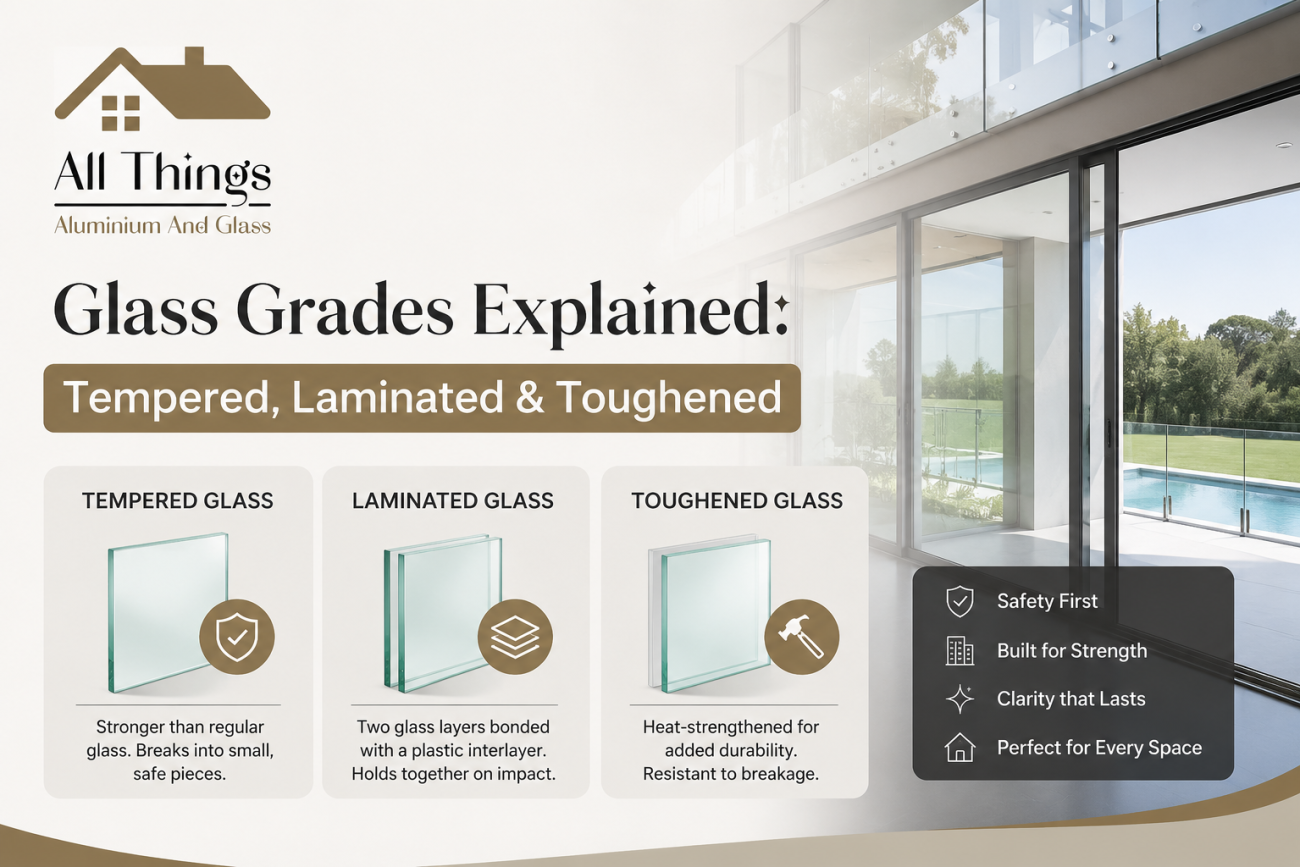
Glass Grades Explained:
Tempered, Laminated & Toughened
Not all glass is created equal. Choosing the wrong grade can compromise safety, performance, and compliance. Here’s everything you need to know before you specify.
Walk into any modern commercial building and you’re surrounded by glass — in the curtain walls, partitions, balustrades, skylights, and shopfronts. But not all that glass is the same. Specify the wrong grade for an application and you’re looking at safety failures, compliance issues, and expensive replacements. This guide explains the three most important safety glass types — tempered, laminated, and toughened — so you can make the right call every time.
At a Glance: The Three Types
Before diving into the detail, here’s a quick reference for each glass grade — what it is, and what it’s primarily used for.
Tempered Glass
Heat-treated for strength. Shatters into small, blunt pieces on impact.
High strengthLaminated Glass
Two or more panes bonded with an interlayer. Holds together when broken.
Best safetyToughened Glass
A form of tempered glass processed to tighter tolerances for critical applications.
High performanceImportant Note
In many markets — including much of Africa, the UK, and the Middle East — “toughened glass” and “tempered glass” are used interchangeably. Technically, they refer to the same process. This guide treats them as one category while highlighting where performance specifications differ. Laminated glass is a distinctly different product.
Tempered Glass: Engineered for Strength
Tempered glass — also called toughened glass — is standard annealed glass that has been subjected to a controlled thermal process. The glass is heated to approximately 620–650°C and then rapidly cooled using high-pressure air jets. This rapid quenching creates a surface compression stress and interior tension that dramatically increases the glass’s mechanical strength.
How strong is it?
Tempered glass is typically four to five times stronger than ordinary annealed glass of the same thickness. A 6mm tempered pane, for example, can withstand far greater wind loads, thermal stress, and impact forces than an equivalent standard glass pane.
How does it break?
This is the defining safety characteristic of tempered glass. When it does break — at a point of impact that overcomes its compression strength — it shatters into thousands of small, relatively blunt fragments rather than large, sharp shards. This dramatically reduces the risk of serious laceration injury, which is why it’s mandated for many applications under building codes.
“When tempered glass breaks, it doesn’t just crack — it disintegrates into a shower of small, blunt granules. That’s the engineering working exactly as intended.”
Key limitations
Tempered glass cannot be cut, drilled, or modified after the tempering process — any such work must be done before tempering. It is also susceptible to a rare phenomenon called spontaneous breakage, typically caused by nickel sulphide inclusions in the raw glass. Heat-soaking treatment can significantly reduce this risk and is recommended for critical overhead or frameless applications.
Typical applications
Frameless shower screens, glass doors, shopfront panels, glass balustrades, automobile side and rear windows, glass table tops, and any application where human impact is a risk.
Laminated Glass: The Gold Standard for Safety
Laminated glass consists of two or more panes of glass permanently bonded together with one or more interlayers — most commonly Polyvinyl Butyral (PVB), but also SentryGlas, EVA (Ethylene Vinyl Acetate), or liquid resin in specialised applications. The bonding is achieved under heat and pressure in an autoclave.
How does it behave when broken?
This is what sets laminated glass apart. When the glass breaks, the fragments adhere to the interlayer rather than falling away. The broken pane remains largely in place — held together by the interlayer — preventing the sudden loss of the glazed opening and significantly reducing injury risk from flying or falling glass.
Beyond basic safety: what the interlayer does
The interlayer in laminated glass does far more than just hold broken pieces together. Depending on its specification, it can provide:
- Acoustic performance — specialised acoustic interlayers (like PVB-A) significantly reduce sound transmission, making laminated glass the first choice for facades in noisy urban environments.
- UV protection — standard PVB blocks up to 99% of UV radiation, protecting interiors and occupants from UV damage without compromising visible light transmission.
- Blast resistance — high-performance interlayers absorb blast energy, making laminated glass essential for government buildings, embassies, and high-security facilities.
- Forced entry resistance — multi-laminate configurations with toughened glass plies can achieve certified attack resistance ratings for doors and windows.
Laminated vs. tempered: which is safer?
For applications where glass is overhead (skylights, glass roofs, canopies) or where the consequence of complete pane loss is serious (high-altitude facades, glass floors), laminated glass is the safer and usually the code-required choice. Tempered glass that shatters completely still creates a sudden hole; laminated glass stays in place.
Key Rule
For overhead glazing, glass floors, balustrade infill panels, and any application where pane retention after breakage is critical — always specify laminated glass. This is not just best practice; it is required by most building codes.
Typical applications
Glass roofs and skylights, glass floors and walkways, balustrade infill panels, curtain walls in high-traffic areas, acoustic partitions, vehicle windscreens, security and blast-rated glazing, hurricane and cyclone-resistant windows.
Toughened Glass: High Performance in Demanding Environments
As noted earlier, “toughened” and “tempered” refer to the same fundamental manufacturing process in most markets. However, in professional specification contexts, “toughened glass” often implies a higher-grade product processed to tighter tolerances, frequently combined with additional treatments like heat soaking or specialist coatings.
Heat-soaked toughened glass
This is the premium tier of toughened glass. After standard tempering, the glass is placed in a heat-soak oven at around 290°C for a set period. This process triggers the breakdown of any nickel sulphide inclusions present in the glass — the primary cause of spontaneous post-installation breakage — causing susceptible panes to break in the oven rather than on a building façade years later.
Heat-soaked toughened glass is strongly recommended — and sometimes mandated — for structural glazing, point-fixed systems, glass fins, and any overhead or frameless application where spontaneous breakage would pose a serious risk.
Chemically toughened glass
A separate process to thermal tempering, chemical toughening (or ion-exchange strengthening) involves submerging glass in a molten potassium salt bath. Larger potassium ions replace smaller sodium ions in the glass surface, creating a surface compression layer. This process can be applied to thinner glass (even 1mm) and to curved or complex-shaped pieces — making it the method of choice for mobile device screens, specialist architectural glass, and appliance panels.
Typical applications
Structural glazing systems, glass fins and bolted glass connections, point-fixed façade panels, frameless glass partitions, overhead glazing (often as part of a laminate), and any application where spontaneous breakage must be minimised.
Choosing the Right Glass Grade for Your Application
The right glass type depends on the application’s safety requirements, structural demands, acoustic needs, and regulatory environment. Here’s a practical guide by use case:
- Shower screens and wet area partitions
- Glass doors (hinged and sliding)
- Shopfronts and entrance screens
- Glass tabletops and furniture
- Side lites adjacent to doors
- Pool fencing and barriers
- Commercial refrigerator doors
- Skylights and glass roofs
- Glass floors and walkways
- Balustrade infill panels
- Acoustic partitions and facades
- Security and blast-rated glazing
- Overhead canopies
- Hurricane / cyclone glazing
- Structural glazing and bolted glass
- Glass fins and structural beams
- Point-fixed curtain wall panels
- Frameless glass systems
- High-risk overhead applications
- Glass roofs in public spaces
- Overhead glazing in high-traffic areas
- High-security and blast-rated facades
- Any application combining structural performance with pane retention
Best Practice
For most overhead and balustrade applications, the ideal specification is toughened laminated glass — combining the strength of thermally toughened glass with the pane retention of laminated construction. This is increasingly the standard required by building codes in commercial applications.
Need Help Specifying the Right Glass for Your Project?
Our team works with architects, quantity surveyors, and contractors to recommend the correct glass grade for every application — from shopfronts to high-rise curtain walls.
Get Expert Advice